
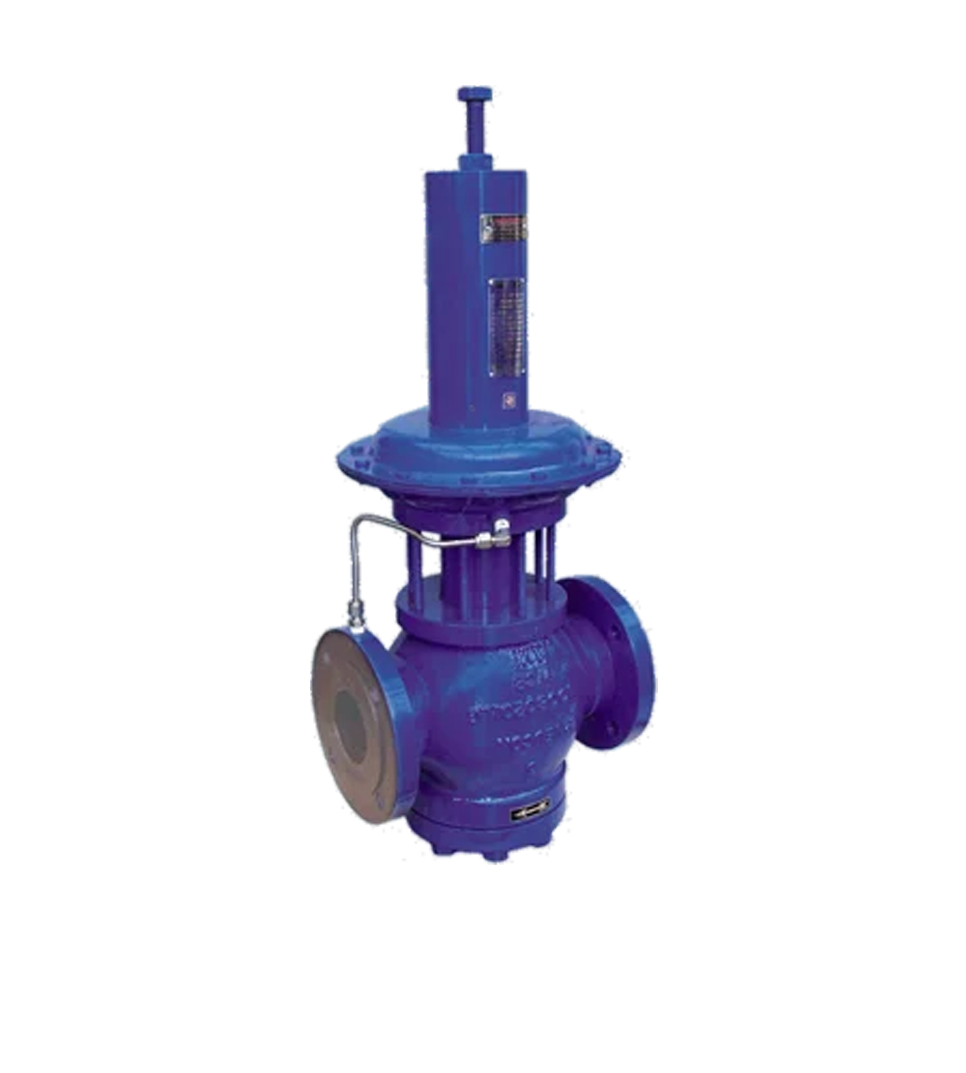
Pressure Regulating Valves

Pressure Regulating Valve is self contained, self Operated control device, which automatically reduce a higher inlet pressure to a steady lower downstream pressure regardless of changing flow rate and varying inlet pressure. It utilizes energy from the controlled system. The regulator operates on the simple principal of force balance. A Downward opening force is exerted by the actuator spring, which is balanced by the upward force exerted by the controlled outlet pressure acting below the diaphragm. Any drop in controlled outlet Pressure due to consumption of Fluid, disturbs the force balance and due to spring force diaphragm and stem move down pushing the valve plug away from seat. This results in the increased flow. The pressure reducing regulators are manufactured in a variety to manage downstream system pressures in low, medium, high flow application; model features a diaphragm/Piston type or combination of both to suit different applications. These regulators find applications throughout many industries including the Oil & Gas, Pulp & Paper, Power Generation and chemicals processing industries etc.

Versatile Service – Models are available for steam, air, gas, or liquid service with internal or external sensing.
Pressure Reduction – Reduces higher inlet pressure to a constant lower outlet pressure for stable operation.
High Sensitivity – Moulded sensing diaphragm provides a good proportional band and excellent control sensitivity.
Glandless Construction – Eliminates gland leakage completely, offering superior sensitivity and repeatability compared to conventional bellow seal designs.
Accurate Outlet Pressure – Maintains precise outlet pressure over a wide range of flow conditions.
Pilot-Operated Design – Main valve is not subjected to pressure fall-off characteristics typical of direct-acting PRVs.
Adjustable Pressure – Outlet pressure is easily adjustable across the complete range of the control spring.
Automatic Operation – Operates automatically off the line pressure without external power.
Reinforced Diaphragm – Heavy-duty, nylon-reinforced diaphragm ensures durability and reliability.
Drip-Tight Closure – Round-shaped, soft seat seal provides drip-tight Class VI closure performance.
Guided Diaphragm Assembly – Diaphragm assembly is guided both top and bottom for precise operation.
Flow Stability – Throttling seat retainer ensures smooth flow and stable pressure control.
Easy Maintenance – Designed for quick maintenance without removing the valve from the line.
Simple Adjustment – Pressure setting can be adjusted easily using a single adjusting screw.
Replaceable Components – Seat ring can be replaced for convenient servicing and extended life.
Material Options – Available in a range of body and diaphragm material combinations to meet diverse application requirements.
IBR Certification – Certified under IBR Form III C for compliance and reliability.
Rugged Design – Engineered to withstand shocks and demanding operating conditions.
Economic Construction – Simple and cost-effective design ensuring performance with affordability.
Design ASME B16.34
Body Form Globe.
Size 15 to 300 mm (1/2” to 12”)
Rating 150# and 300# ANSI.
Higher rating on request.
End Connection Flanged – 15mm to 300mm (1/2” to 12”)
Screwed – 15mm to 50mm (1/2” to 2”)
Body Material A216 Gr. WCB, A351 CF8, CF8M, other on request.
Trim Material Stainless Steel, Alloy 20, Monel, Hastelloy B/C, Stellite Hard Facing.
Max. Temp As per the diaphragm limitations.
Seat Leakage As per FCI-70.02 (ANSI B16.104) Class IV, V, and VI
(Standard Leakage Rates)
Metal to Soft Seating – Bubble tight (Zero Leakage)