
PRS / PRDS Systems
Pressure Reducing & Desuperheating Stations

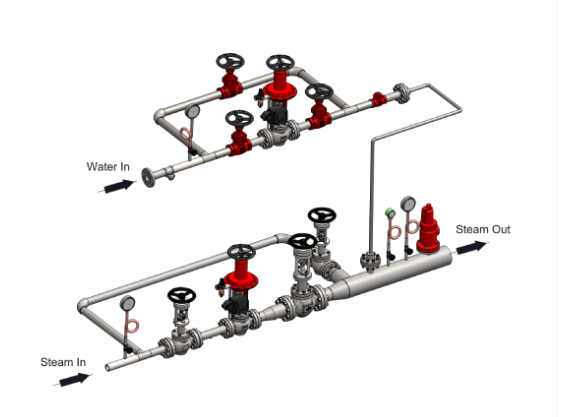
The Pressure Reducing Desuperheating Station(PRDS) solves dual challenges by combining precise pressure regulation and temperature control in a single, cohesive unit. Unmanaged high-pressure, superheated steam systems face risks like water hammer, pipe fatigue, and energy waste due to inefficient pressure-temperature profiles. Engineered for critical applications, this desuperheater control station integrates a multi-stage Pressure Reducing Valve (PRV) with a high-efficiency desuperheater and temperature control valve (TCV), ensuring steam conditions are tailored to downstream needs.

The pressure reducing desuperheating system employs cascade control logic; the PRV first reduces pressure, followed by the desuperheater valve (DSH) and temperature control valve (TCV) injecting atomized water to fine-tune temperature. Advanced stations feature V-port trims for linear pressure control and sonic spray nozzles to prevent droplet coalescence, ensuring no wet steam reaches equipment. Real-time PID loops sync with RTD sensors and pressure transmitters, enabling sub-2-second response to load shifts.

Compliant with API 520 and EN 12952-7, pressure reducing desuperheating stations include strainers, thermal relief valves, and isolation valves (Gate, Globe, Check) for low maintenance and high efficiency.By harmonizing pressure and enthalpy, this pressure reducing and desuperheating system eliminates flashing, cavitation, and thermal shock, slashing energy losses by 15% and extending piping life. Its modular design allows retrofitting into legacy systems, making it indispensable for engineers prioritizing safety and efficiency in steam networks.

Streamlined Operation – Combines pressure reduction and desuperheating in one unit for efficient operation.
High-Pressure Steam Handling – Designed for handling high-pressure steam systems, such as those in power plants.
Precise Pressure Reduction – Ensures accurate pressure reduction for downstream safety and protection.
Superheated Steam Compatibility – Suitable for use in superheated steam applications.
Efficient Temperature Reduction – Reduces steam temperature efficiently using atomized water injection.
Adjustable Temperature Control – Offers precise control over steam temperature with adjustable settings.
Corrosion-Resistant – Built to withstand high-temperature steam and water, ensuring longevity and durability.
Stable Outlet Conditions – Maintains consistent and stable outlet conditions under various operating conditions.
Reduced Acoustic Impact – Designed to minimize noise levels in industrial environments.
Zero Leakage – Guarantees no leakage, ensuring safe operation in critical steam systems.
Overpressure Prevention – Prevents overpressure situations, safeguarding equipment and system integrity.
Safety Compliance – Fully compliant with global safety standards, ensuring safe and reliable operation.
Robust Integration – Easily integrates into steam pipelines for seamless operation.
Compact Modular Design – Features a space-saving, modular design that can be customized for various applications.
Variety in Size/Material – Available in various sizes and materials to suit different operational needs.
Type Integrated station with PRV, desuperheater, and control system
Inlet Pressure Range 200–1200 psi (13.8–82.7 bar)
Outlet Pressure Range Adjustable 50–600 psi (3.4–41.3 bar)
Steam Temperature Range Up to 600°C (1112°F)
Desuperheater Spray Water Pressure 100–300 psi (6.9–20.7 bar)
Spray Water Flow Rate 0.5–50 GPM (1.9–189 LPM)
Body Material WCC, WC6, WC9, Alloy Steel
Control System PLC/PID-based automation with temperature/pressure sensors
Noise Level <85 dB(A)
Leakage Class ANSI Class VI (bubble-tight)
Safety Features Thermal relief valve, fail-safe closure
Certifications ASME B31.1, PED 2014/68/EU, ISO 9001
Connection Types Flanged (DN50–DN300), Welded
Dimensions Customizable (typical: 1–3 meters length)
Weight 50–500 kg (110–1100 lbs)